

To determine the location of an acupoint, in addition to exploring sensations, it is often based on various surface landmarks, especially bony landmarks. Since bony landmarks are relatively constant, Lingshu-Gudu uses them as the primary reference to measure the length or width of various parts of the body and, based on proportional sizes, uses surface landmarks as the standard. The distance between certain areas is defined as a specific measurement, called "bone proportional measurement." Using this standard to analyze and determine acupoints is called the "bone proportional method." Later, based on the bone proportional method, the finger measurement method was also applied.
According to the specified bone proportional measurement, the acupoints can be determined, supplementing the limitations of surface landmark positioning. Yang Shang-shan said: "The flesh and skin of a person may vary in thickness, but the joints' dimensions do not stretch or shrink; therefore, to determine the length of the meridians, one must first refer to bone proportional measurement." "Using this as a fixed standard, the length of the meridians can be established, and acupoints can be located." The scale for dividing and measuring is based on the individual's body size, regardless of differences in height or weight. The same measurement is applied to the same area for everyone, hence it is later referred to as the "body cun method." The Complete Medical Works of Ancient and Modern Times states: "The ancients specifically emphasized the body cun method because it must be applied uniformly to the body, ensuring no errors due to differences in weight or height."
Lingshu-Gudu measured the standard human height as 7 chi 5 cun, with the horizontal span (arms extended) also being 7 chi 5 cun, and proportionally defined the measurements for various parts of the body (see the attached table). For clinical convenience in locating acupoints, the measurements for certain areas slightly differ from Lingshu. For example, the forearm from the elbow to the wrist is measured as 12 cun, originally 12.5 cun. The lower abdomen from the navel to the upper edge of the pubic symphysis Lingshu was originally set at 6.5 cun, but is now generally taken as 5 cun. In terms of actual length, 1 cun here is longer than 1 cun in the upper abdomen. Therefore, some also measure it as 6 cun.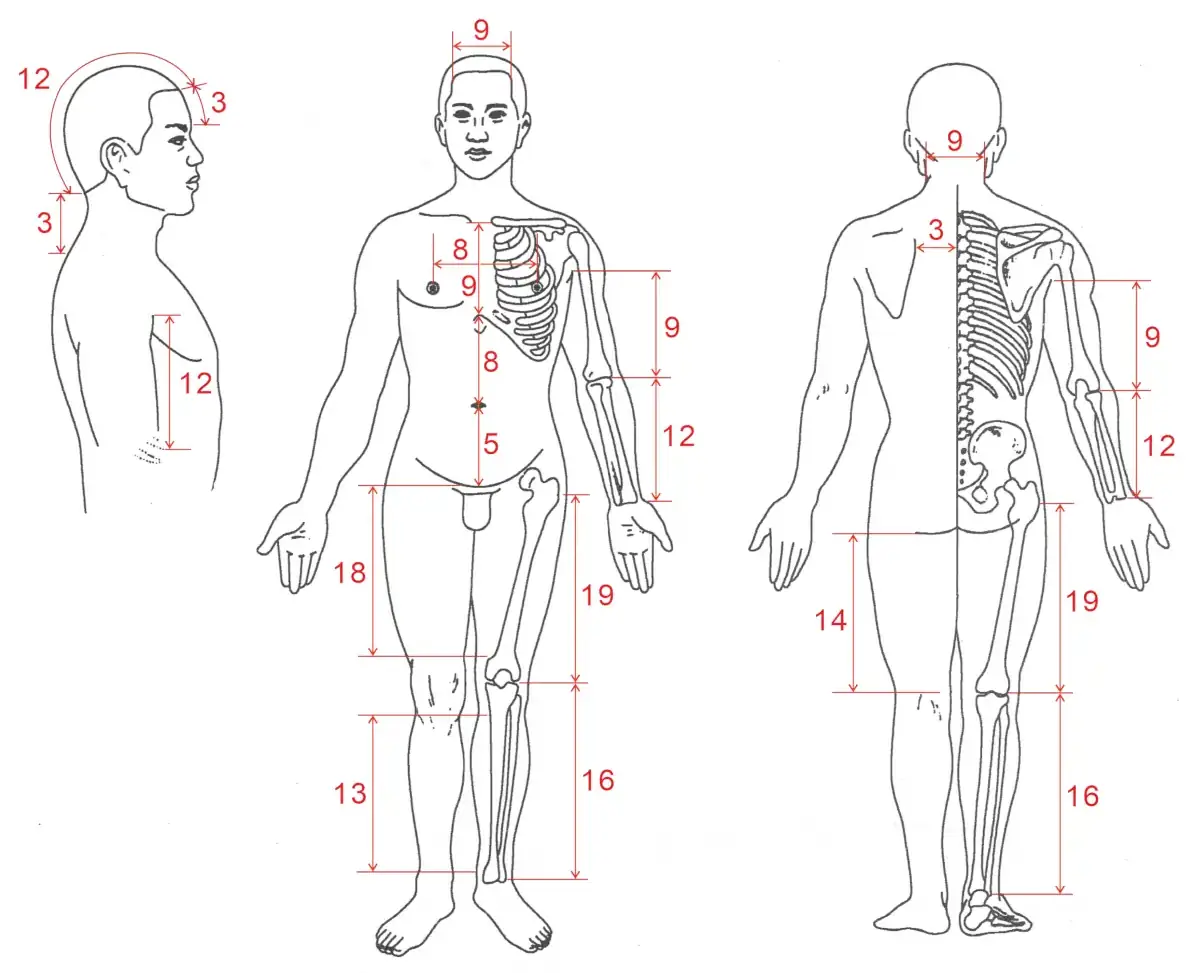
Vertical measurement: The distance between the front and back hairlines is measured as 12 cun, serving as the basis for vertical measurements on the top of the head. If the front hairline is not clear, measure upward from the midpoint between the eyebrows (Yintang (EX-HN3)); if the back hairline is not clear, measure upward from below the occipital bone (Fengfu (GV16)), subtracting 1 cun; or measure upward from the spinous process of the seventh cervical vertebra (Dazhui (GV14)), adding 3 cun.
Horizontal measurement: The distance between the two mastoid processes (Wangu (GB12)) or the two hair corners (Touwei (ST8)) is measured as 9 cun (4.5 cun on each side), serving as the basis for horizontal measurements on the head. For practical acupoint location, divide the distance from the mastoid process or hair corner to the midline into three equal parts, with each part being 1.5 cun.
(2) Back
Vertical measurement: The vertical distance is based on the spinous processes of the vertebrae.
Horizontal measurement: Between the medial borders of the scapulae – 6 cun (3 cun on each side); between the sacroiliac joints – 3 cun (1.5 cun on each side), serving as the basis for the horizontal cun measurement on the back. From the acromion to the posterior midline – 8 cun.
(3) Chest and Abdomen
Vertical measurement: The vertical distance of the chest (vertical cun) is based on the intercostal spaces.
Abdomen, from the sternal angle (Qigu, above the xiphoid process) to the center of the navel—8 cun;
From the center of the navel to the upper edge of the pubic symphysis—5 cun (or from the center of the navel to the pubic symphysis as 6 cun), serving as the basis for the vertical cun of the abdomen.
Lateral side, from the center of the armpit to the hypochondrium (11th rib)—12 cun.Horizontal measurement: Between the two nipples or the midpoint of the two clavicles (Quepen (ST12))—8 cun (4 cun on each side), serving as the basis for the horizontal cun of the chest and abdomen.
(4) Upper Limbs
Upper arm, from the armpit crease to the elbow crease—9 cun.
Forearm, from the elbow crease (level with the tip of the elbow) to the wrist crease—12 cun, serving as the basis for the vertical cun of the inner and outer sides of the upper limbs.
(5) Lower Limbs
Thigh, from the greater trochanter of the femur (Huantiao (GB30)) to the center of the knee (the connection between the lateral condyle of the femur and the lateral condyle of the tibia)—19 cun;
From the upper edge of the pubic symphysis to the upper edge of the patella—18 cun, serving as the basis for the vertical cun of the outer or inner side of the thigh.
Back of the thigh, from the gluteal crease (Chengfu (BL36)) to the popliteal crease (Weizhong (BL40)) can be measured as 15 cun.
Lower leg, from the center of the knee (Xiyan (EX-LE5), Weizhong (BL40)) to the level of the prominence of the lateral malleolus (Jiexi (ST41), Kunlun (BL60))—16 cun; from below the medial condyle of the tibia (Yinlingquan (SP9)) to the level of the prominence of the medial malleolus (Taixi (KI3))—13 cun, serving as the basis for the vertical cun of the outer or inner side of the lower leg.
Commonly used bone proportional measurements table
| Part | Start and end points | Measurement in cun | Measurement method | Notes |
| Head
Region | From the anterior hairline to the posterior hairline | 12 cun | Vertical | If the anterior hairline is unclear, measure from the glabella to Dazhui (GV14) as 18 cun, from the glabella to the anterior hairline as 3 cun, and from Dazhui (GV14) to the posterior hairline as 3 cun |
| Between the two hair corners on the forehead | 9 cun | Horizontal | Used for measuring the horizontal cun of the head | |
| Between the two Wangu (GB12) (mastoid processes) behind the ears | 9 cun | Horizontal | ||
| Chest
Abdomen Region
| From Tiantu (CV22) to Qigu (sternocostal angle) | 9 cun | Vertical | For locating points vertically in the chest and hypochondriac region, generally based on the ribs, each rib fracture is considered as 1.6 cun (from Tiantu (CV22) to Xuanji (CV21) can be considered as 1 cun, from Xuanji (CV21) to Zhongting (CV16), each point can be considered as 1.6 cun) |
| From the sternum to the navel | 8 inches | Straight | ||
| From the navel to Henggu (KI11) Shanglian (LI9) (upper border of the pubic symphysis) | 5 inches | Straight | ||
| Between the two nipples | 8 inches |
Horizontal | For locating acupoints in the chest and abdomen, the horizontal measurement can be based on the distance between the two nipples. For females, the midclavicular line can be used as a substitute. | |
| Length of Henggu (KI11) (pubic bone) | 8 inches | Horizontal | The length of Henggu (KI11) serves as a horizontal measurement landmark for the groin area of the lower abdomen. | |
| Back and waist area | From Dazhui (GV14) to the tailbone | 21 vertebrae | Straight | The acupoints on the back and waist are located using the spinous processes of the vertebrae as landmarks. |
| Side of the body | From below the armpit to the hypochondrium | 12 inches | Straight | The hypochondrium refers to the end of the 11th rib. |
| From the hypochondrium to the hip joint | 9 inches | Straight | The hip joint refers to the greater trochanter of the femur. | |
| Upper limb area | From the anterior axillary fold to the cubital crease | 9 inches | Straight | Used for the measurement of the three yin and three yang meridians of the hand. Bone proportional measurement |
| From the cubital crease to the wrist crease | 12 inches | Straight | ||
| Lower limb area
| From Henggu (KI11) Shanglian (LI9) to the inner fibula and radius Shanglian (LI9) | 18 inches | Straight | Used for the measurement of the three yin meridians of the foot. Bone proportional measurement |
| From the inner fibula and radius Xialian (LI8) to the tip of the inner ankle | 13 inches | Straight | ||
| From the hip joint to the middle of the knee | 19 inches | Straight | Used for the bone proportional measurement of the three yang meridians of the foot. The distance from the gluteal fold to the middle of the knee can be measured as 14 cun. The horizontal line at the middle of the knee, in front, aligns with the lower edge of the kneecap, and behind, aligns with the transverse crease of the knee. When the knee is bent, it aligns with the Dubi (ST35) acupoint. | |
| From the center of the knee to the tip of the external malleolus | 16 inches | Straight | ||
| From the tip of the external malleolus to the sole of the foot | 3 inches | Straight |