

search
arrow_drop_down
smart_toy
hearing
bubble_chart Content 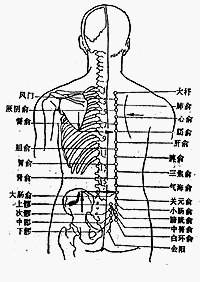 1.5 cun lateral to the lower border of the spinous process of the fifth thoracic vertebra (Shendao (GV11)) on the back.
Xinshu BL15
﹝Name Explanation﹞
The point corresponds to the heart and is the back-shu point of the heart.
﹝Category﹞
Heart back-shu point. Lingshu-Weiqi: "The root of hand shaoyang is at the tip of the sharp bone, and its mark is at the back shu point."
﹝Source﹞
Lingshu-Beishu.
﹝Location﹞
- Lingshu-Beishu: "Between the fifth vertebra, ... 3 cun lateral to the spine" ;
- Zhenjiu Jiayi Jing: "1.5 cun lateral to the lower border of the fifth thoracic vertebra" ;
- Suwen-Xieqi Xingzhi: "To locate Beishu, first measure the distance between the two nipples and fold it in half; then use another straw to measure half of that distance and place it diagonally. Use this to measure the back: place one corner at the top, aligned with the spine at Dazhui (GV14); the other two corners will point downward. The lower corner corresponds to the lung shu point; one grade lower is the heart shu point" ; this corresponds to a point 2 cun lateral to the spinous process of the sixth thoracic vertebra.
- Qianjin Yaofang: "Another source states it is at the seventh vertebra, opposite to the heart, 3 cun lateral to Sanjian (LI3)."
﹝Local Anatomy﹞
- Muscles: Trapezius, rhomboid muscle, and deep layer is the longissimus muscle (inside the thoracic cavity is the lower lobe of the lung).
- Nerves: Medial cutaneous branch of the posterior ramus of the fifth or sixth thoracic nerve, deep layer is the lateral branch of the posterior ramus.
- Blood vessels: Medial branch of the dorsal branch of the fifth intercostal artery and vein.
﹝Acupuncture and Moxibustion﹞
Oblique insertion downward or toward the spine 0.5~0.8 cun. Do not insert too deeply to avoid entering the thoracic cavity and injuring the lung. Moxa cone moxibustion 3~5 cones, or warm moxibustion with moxa stick for 10~15 minutes.﹝Effects﹞
Calms the heart, soothes the mind, and clears heat from the five zang-organs.
﹝Indications﹞
- Classical: Chills and fever, heart pain, restlessness in the chest, cough, hematemesis, vomiting, loss of appetite, malaria, manic and depressive psychosis, epilepsy, night sweating, insomnia, forgetfulness, shortness of breath, abdominal distension and fullness, indigestion, epistaxis, pain below the ribs, excessive salivation, frequent hiccups, jaundice, heartache radiating to the back, heart deficiency with fright and vigilance, hematochezia, dysphagia, back gangrene, eye pain, eye swelling, blurred vision, redness of the white of the eye, deficiency fatigue.
- Modern: Heart diseases, lower digestive tract bleeding, neurasthenia, epilepsy, schizophrenia, intercostal neuralgia, bronchitis, arrhythmia.
﹝Prescription Examples﹞
- Heart distension: Xinshu (BL15), Lieque (LU7).
- Frequent wind epilepsy: Shendao (GV11), Xinshu (BL15).
- Eye pain: Xinshu (BL15), Yin Qiao.
- Cough with bloody sputum: Xinshu (BL15), Ganshu (BL18), Quepen (ST12), Juque (CV14), Jiuwei (CV15).
- Dementia: Xinshu (BL15); Shenmen (HT7).
- Nocturnal emission: Xinshu (BL15), Shenshu (BL23).
- Insomnia: Xinshu (BL15), Weishu (BL21), Zhongwan (CV12), Shenmen (HT7), Fenglong (ST40).
- Arrhythmia: Xinshu (BL15), Shenmen (HT7), Neiguan (PC6), Yanglingquan (GB34) penetrating to Yinlingquan (SP9).
- Palpitation, severe palpitation: Xinshu (BL15), Juque (CV14), Shenmen (HT7), Neiguan (PC6).
- Psychosis: Xinshu (BL15), Ganshu (BL18), Pishu (BL20), Shenmen (HT7), Fenglong (ST40).