

Main Stimulation Areas
There are currently over a hundred hand acupoints discovered. Here, we introduce 40 commonly used and clinically effective points.
I. Basic Hand Acupoints
There are 18 basic hand acupoints.
1. Lumbago-Leg Point
[Location] On the radial side of the extensor tendon of the second finger and the ulnar side of the extensor tendon of the fourth finger, 1.5 cun anterior to the wrist crease. Two points on each side.
[Indications] Acute lumbar sprain, lumbago and leg pain.
2. Ankle Point
[Location] At the junction of the red and white skin on the radial side of the thumb metacarpophalangeal joint.
[Indications] Acute ankle sprain, swelling and pain in the ankle.
3. Chest Point
[Location] At the junction of the red and white skin on the radial side of the thumb interphalangeal joint.
[Indications] Chest tightness, chest pain, vomiting, diarrhea, epilepsy, etc.
4. Eye Point
[Location] At the junction of the red and white skin on the ulnar side of the thumb interphalangeal joint.
[Indications] Redness, swelling, and pain in the eyes, stye, electronic ophthalmia, and other eye diseases.
5. Shoulder Point
[Location] At the junction of the red and white skin on the radial side of the metacarpophalangeal joint.
[Indications] Acute shoulder sprain, scapulohumeral periarthritis, etc.
6. Forehead Point (also known as Lanwei (EX-LE7) Point)
[Location] At the junction of the red and white skin on the radial side of the first interphalangeal joint of the index finger.
[Indications] Forehead headache, gastrointestinal disorders, simple appendicitis, etc.
7. Vertex Point
[Location] At the junction of the red and white skin on the radial side of the first interphalangeal joint of the middle finger.
[Indications] Neuralgic headache, vertex pain, dysmenorrhea, etc.8. Migraine Point
[Location] At the junction of the red and white skin on the ulnar side of the first interphalangeal joint of the ring finger.
[Indications] Migraine, ear pain, intercostal neuralgia, biliary colic, etc.
9. Huiyin (CV1) Point
[Location] At the junction of the red and white skin on the radial side of the first interphalangeal joint of the little finger.
[Indications] Pain in the Huiyin (CV1) area, dysmenorrhea, leukorrhea, and anal fissure, etc.
10. Occipital Point (also known as Tonsil Point)
[Location] At the junction of the red and white skin on the ulnar side of the first interphalangeal joint of the little finger.
[Indications] Occipital headache, acute tonsillitis, armpit pain, arm pain, hiccup, cheek pain, etc.
11. Spine Point
[Location] At the junction of the red and white skin on the ulnar side of the metacarpophalangeal joint of the little finger.
[Indications] Acute lumbar sprain, herniation of intervertebral disc, sacrococcygeal pain, tinnitus, stuffy nose, etc.
12. Sciatic Nerve Point
[Location] Between the fourth and fifth metacarpophalangeal joints, near the fourth metacarpophalangeal joint.
[Indications] Sciatica, hip and buttock pain, etc.
13. Throat Point (also known as Tooth Point)
[Location] Between the third and fourth metacarpophalangeal joints, near the third metacarpophalangeal joint.
[Indications] Acute tonsillitis, pharyngitis, toothache, trigeminal neuralgia, etc.
14. Neck Point (also known as Stiff Neck Point)
[Location] Between the second and third metacarpophalangeal joints, near the second metacarpophalangeal joint.
[Indications] Stiff neck, neck contusion, cervical spondylosis, etc.
15. Gastrointestinal Point[Location] At the midpoint of the line connecting Laogong (PC8) and Daling (PC7).
[Indications] Chronic gastritis, ulcer disease, indigestion, biliary ascariasis, etc.
16. Cough-Asthma Point
[Location] On the palm, at the ulnar side of the metacarpophalangeal joint of the index finger.
[Indications] Bronchitis, bronchial asthma, neuralgic headache, stiff neck, etc.
17. Nocturnal Enuresis Point
[Location] At the midpoint of the transverse crease of the second interphalangeal joint of the little finger on the palm.
[Indications] Infantile enuresis, frequent and urgent urination, etc.
18. Heel Point
[Location] At the midpoint of the line connecting the Gastrointestinal Point and Daling (PC7).
[Indications] Heel pain, etc.
II. Additional Hand Acupoints
Many new hand acupoints have been added. Below is a brief introduction to 22 selected points.
1. Hemostasis Point
【Location】On the dorsum of the hand, at the midpoint of the ring finger line on the wrist crease.
【Indications】Stops bleeding from various causes, sprain of ankle joint, etc.
2. Nose Point
【Location】On the dorsum of the hand, at the center of the bone prominence of the metacarpophalangeal joint of the ring finger.
【Indications】Stuffy nose, runny nose, allergic rhinitis, etc.
3. Blood Pressure Elevation Point
【Location】At the midpoint of the wrist crease on the dorsum of the hand.
【Indications】Blood pressure drop due to various causes.
4. Hiccup Point
【Location】At the midpoint of the transverse crease of the second phalangeal joint of the middle finger on the dorsum of the hand.
【Indications】Hiccup, etc.
5. Fever Reduction Point
【Location】At the radial side of the web between the middle and ring fingers.
【Indications】Fever, diarrhea, etc.6. Diarrhea Point (also known as Anti-Diarrhea Point)
【Location】1 cun above the third and fourth metacarpophalangeal joints on the dorsum of the hand.
【Indications】Acute and chronic diarrhea.
7. Malaria Point
【Location】At the junction of the first metacarpal bone and the wrist joint, on the radial side of the large Yuji (LU10).
【Indications】Malaria attacks.
8. Tonsil Point (also known as Yuji (LU10) Point)
【Location】At the midpoint of the first metacarpal bone on the palmar side.
【Indications】Tonsillitis, pharyngitis, etc.
9. Emergency Point
【Location】2 fen from the nail edge at the tip of the middle finger.
【Indications】Unconsciousness, summerheat stroke, and other critical conditions.
10. Convulsion Calming Point
【Location】At the junction of the large and small Yuji (LU10) on the palm.
【Indications】Febrile convulsions in children.
11. Spleen Point
【Location】At the midpoint of the transverse crease of the thumb joint on the palmar side.
【Indications】Spleen-stomach disharmony, indigestion, abdominal distension and fullness, diarrhea, etc.
12. Small Intestine Point
【Location】At the midpoint of the transverse crease between the first and second phalangeal joints of the index finger on the palmar side.
【Indications】Small intestine meridian disorders.
13. Large Intestine Point
【Location】At the midpoint of the transverse crease between the second and third phalangeal bones of the index finger on the palmar side.
【Indications】Large intestine meridian disorders, diarrhea, constipation, appendicitis, etc.
14. Triple Energizer Point
【Location】At the midpoint of the transverse crease between the first and second phalangeal bones of the middle finger on the palmar side.
【Indications】Triple energizer meridian disorders, chest, abdominal, and pelvic diseases.
15. Heart Point
【Location】At the midpoint of the transverse crease between the second and third phalangeal bones of the middle finger on the palmar side.
【Indications】Palpitation, heart pain, arrhythmia, insomnia, etc.
16. Liver Point
【Location】At the midpoint of the transverse crease between the first and second phalangeal bones of the ring finger on the palmar side.
【Indications】Hypochondriac region pain, stomach distension, etc.
17. Lung Point
【Location】At the midpoint of the transverse crease of the second phalangeal joint of the ring finger on the palmar side.
【Indications】Cough, panting, chest tightness, etc.
18. Mingmen (GV4) Point
【Location】At the midpoint of the transverse crease between the first and second phalangeal bones of the little finger on the palmar side.
【Indications】Seminal emission, impotence, and kidney-deficiency lumbago.
19. Asthma Point
【Location】Between the fourth and fifth metacarpophalangeal joints on the palmar side.
【Indications】Bronchial asthma.
20. Itching Relief Point
【Location】1 cun anterior to the ulnar side of the wrist crease, at the junction of the red and white skin.
【Indications】Skin itching and allergic skin diseases.
21. Sleep Point
【Location】On the dorsum of the hand, at the midpoint between Hegu (LI4) and Sanjian (LI3) points.
【Indications】Insomnia.
22. Hyperthyroidism Point
【Location】On the dorsum of the hand, on the midline of the little finger, behind the wrist crease, in the depression anterior to the ulna. {|165|}【Indications】Hyperthyroidism.
(Attached image):
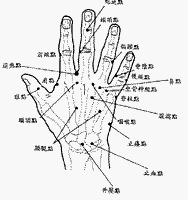
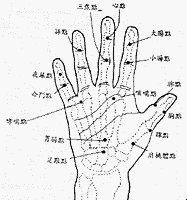
1. Basic Hand Acupoints
2. Additional Hand Acupoints
Acupoint Selection and Prescription
I. Methods of Acupoint Selection
Hand acupuncture therapy involves three methods of acupoint selection.
(1) Regional Selection Method: This involves selecting hand acupoints corresponding to the location of the disease or the affected organ. For example, for eye disease, select the eye point; for shoulder pain, select the shoulder point; for lumbar sprain, select the lumbar-leg point, etc.
(2) Symptomatic Selection Method: This involves selecting hand acupoints based on specific symptoms, such as selecting the cough-asthma point for cough and asthma, and the enuresis point for nocturnal enuresis in children, etc.
(3) Selection Based on Traditional Chinese Medicine Theory: This involves selecting acupoints based on the traditional zang-fu organ meridian and collateral theory. For example, select the heart point for insomnia because the heart governs mental activity; select the liver point for eye diseases because the liver is associated with the eyes, etc. II. Prescription Methods
Hand acupuncture prescriptions are divided into two methods.
(1) Single Prescription Method: This involves selecting acupoints based on any one of the above selection methods. For example, for acute lumbar sprain, often only selecting the lumbar-leg point on one side can be effective.
(2) Combined Prescription Method: This involves combining acupoints selected by multiple selection methods. For example, for skin itching, select the anti-itching point based on symptoms; select the lung point based on the Chinese medicine theory "the lung governs the skin and body hair," and combine them into a prescription.
Generally, hand acupuncture therapy prescriptions should be precise, with 1 to 3 acupoints being appropriate. Additionally, this therapy emphasizes the principle of selecting acupoints on the opposite side of the disease, i.e., if the left side is affected, select acupoints on the right side; if the right side is affected, select acupoints on the left side; if both sides are affected or for internal organ diseases, select acupoints on both sides.
Operational Methods
I. Needle Tools: Use 28-30 gauge 0.5-1 inch stainless steel filiform needles.
II. Needle-Inserting Method: Hand acupuncture therapy varies in needle insertion depending on different acupoints.
(1) General Needle-Inserting Method: Have the patient's hand in a naturally curved position, the practitioner holds the filiform needle, with the needle tip close to the outer side of the bone membrane and perpendicular to the palm surface, insert perpendicularly into the acupoint, ensuring not to penetrate the bone membrane, with a depth of 2-5 fen. This method is suitable for most hand acupoints.
(2) Special Needle-Inserting Method: This method varies depending on the acupoint. For the lumbar-leg point, the needle body should form a 45-degree angle with the skin surface, with the needle tip slightly towards the palm, inserted between the extensor tendon and the metacarpal bone, with a depth of about 3-5 fen. During insertion, the patient should slightly clench their fist, with the wrist joint in a dorsiflexed position. For the sciatic nerve point, first insert perpendicularly, with a depth of about 2 fen, until reaching the bone, obtain the qi needling sensation, then slightly retain the needle, then lift the needle and insert obliquely towards the shaoyang meridian line, also until reaching the bone. III. Needle Manipulation Method: Generally, a small amplitude twisting method is used. For treating pain and sexually transmitted diseases, a larger amplitude twisting combined with lifting and thrusting strong stimulation technique is required, with continuous needling manipulation for 2-3 minutes. The patient is advised to move the affected area as much as possible or perform local tuina, and after the pain stops, continue needling for 1-3 minutes.
IV. Retaining Needle Method: The retaining needle time for hand acupuncture therapy is 5-15 minutes, and for painful conditions, the retaining needle time can be appropriately extended. For some diseases, intermittent retaining needle method can be used, such as for treating insomnia with the sleep point, first insert perpendicularly 0.5-1 inch, twist for 2 minutes, retain the needle for 2 minutes, then twist for 2 minutes and retain the needle until sleepiness appears.
Hand acupuncture therapy for acute sexually transmitted diseases can be performed 1-2 times daily, without counting the course; for chronic sexually transmitted diseases, perform once daily or every other day, with 10 sessions as a course.
Precautions
I. The needling sensation of hand acupuncture therapy is stronger than body acupuncture, so it is advisable to fully explain to the patient before treatment to avoid fainting.
II. When needling hand acupoints, especially when inserting obliquely along the bone membrane, it is easy to injure the bone membrane, so the filiform needle should be inserted between the tendon and the bone membrane to prevent injury.
III. Strict disinfection should be observed to prevent infection.
Indications
According to incomplete statistics, hand acupuncture therapy has been applied to the treatment of more than 50 diseases. Among them, it is most effective for various acute pain conditions, such as acute lumbar sprain, headache, gastric spastic pain, dysmenorrhea, sciatica, biliary ascariasis, etc.
Secondly, it also has a good effect on agalactia, infantile enuresis, bronchitis, asthma, arrhythmia, abdominal pain, diarrhea, insomnia, and skin pruritus.