

Main Stimulation Areas
I. Commonly Used Points
There are six commonly used points on the radial side of the second metacarpal bone.
1. Head Point
[Location] On the radial side of the distal end of the second metacarpal bone.
[Indications] Disorders of the head, eyes, ears, nose, mouth, and teeth.
2. Foot Point
[Location] On the radial side of the proximal end of the second metacarpal bone.
[Indications] Disorders of the foot and ankle.
3. Stomach Point
[Location] Midpoint between the Head Point and the Foot Point.
[Indications] Disorders of the stomach, spleen, and pancreas.
4. Lung-Heart Point
[Location] Midpoint between the Head Point and the Stomach Point.
[Indications] Disorders of the lungs, heart, chest, mammary glands, lower trachea, bronchi, lower esophagus, and back.
5. Liver Point
[Location] Midpoint between the Lung-Heart Point and the Stomach Point.
[Indications] Disorders of the liver and gallbladder.
6. Waist Point
[Location] Midpoint between the Stomach Point and the Foot Point.
[Indications] Disorders of the waist, periumbilical region, large intestine, and small intestine.
II. Additional Points
1. Neck Point
[Location] At the junction of the upper 1/3 and middle 1/3 of the line connecting the Head Point and the Lung-Heart Point.
[Indications] Disorders of the neck, thyroid, throat, upper trachea, and upper esophagus.
2. Points of Upper Extremities (EX-UE)
[Location] At the junction of the middle 1/3 and lower 1/3 of the line connecting the Head Point and the Lung-Heart Point.
[Indications] Disorders of the shoulder, upper limbs, elbow, hand, wrist, middle trachea, and middle esophagus.
3. Duodenum Point
[Location] At the junction of the upper 1/3 and middle 1/3 of the line connecting the Stomach Point and the Waist Point.
[Indications] Disorders of the duodenum and colon.4. Kidney Point
[Location] At the junction of the middle 1/3 and lower 1/3 of the line connecting the Stomach Point and the Waist Point.
[Indications] Disorders of the kidney, large intestine, and small intestine.
5. Lower Abdomen Point
[Location] At the junction of the upper 1/3 and middle 1/3 of the line connecting the Waist Point and the Foot Point.
[Indications] Disorders of Zigong (EX-CA1), lower abdomen, bladder, rectum, Lanwei (EX-LE7), ovaries, testes, vagina, urethra, anus, and sacrum.
6. Leg Point
[Location] At the junction of the middle 1/3 and lower 1/3 of the line connecting the Waist Point and the Foot Point.
[Indications] Disorders of the leg and knee.
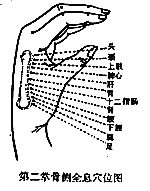
(Illustration): Diagram of Points on the Radial Side of the Second Metacarpal Bone
Diagnostic Method
I. Method
Mainly using the pressing method. Taking the patient's right side as an example, the examiner sits or stands opposite the patient, holds the patient's right hand with their right hand, instructs the patient to hold their hand as if holding an egg, with the purlicue facing upward, the fingertips of the index finger and thumb 3 cm apart, and the muscles relaxed. The examiner uses the tip of their left thumb to press vertically on the acupoint, with a slight kneading motion. First, apply moderate pressure and knead 1-3 times. When the patient feels obvious soreness, distension, heaviness, or numbness, increase the pressure appropriately. If the patient shows an avoidance reaction, this point can be identified as a tender point. Start pressing from the Head Point and proceed in order for diagnosis. If examining the patient's left hand, the actions are the opposite of the above.
II. SignificanceThe appearance of tender points generally indicates the following three situations: 1. There is a disorder in the corresponding area. For example, tenderness at the Head Point indicates a disorder in the head, eyes, ears, nose, mouth, or teeth; 2. There is a disorder in the corresponding zang-fu organ. For example, tenderness at the Lung Point may indicate a disorder in the lungs, nose, or skin; 3. It indicates which side the disorder is more severe on. For example, if the tender point on the right hand is more pronounced than on the left, the disorder may be more severe on the right side, and vice versa.
For disorders with clear localization, the diagnostic rate is higher; for systemic diseases with unclear localization, tenderness is often not obvious.
Point Selection and Prescription
I. Point Selection
There are generally three methods.
(1) Select acupoints according to the principle of regional correspondence. For example, select the liver acupoint for liver and gallbladder diseases; select the stomach acupoint for stomach, spleen, and pancreas diseases, etc. For specifics, refer to the section on acupoint areas for the locations treated by each acupoint.
(2) Select acupoints according to the principle of ipsilateral correspondence. That is, on the basis of the above acupoint selection, also select acupoints on the same side as the affected area. For example, if the affected area is on the left side of the body, it is appropriate to select the acupoint on the left side of the second metacarpal bone.
(3) Select acupoints according to the principle of correspondence to the zang-fu organs, that is, according to Chinese medicine theory. For example, according to the theory that the liver governs the design of strategy, acupoints on the liver can be selected for emotional and mental disorders; the spleen governs muscles, so acupoints on the spleen can be selected for muscle disorders, etc.
II. PrescriptionThe second metacarpal bone side acupuncture method emphasizes the principle of fewer needles and precise acupoint selection in prescription, meaning that the acupoints in the prescription are valued for their scarcity. The above single or combined two acupoint selection methods can be used to formulate the prescription, but generally, it should not exceed two acupoints. This is because the human body is a pan-control system, and inputting strong information from fewer directions can mobilize a stronger response from the whole body to this information, achieving better results. Only by selecting acupoints accurately can the reliability of the input information be ensured.
Operation Method
1. Needle tools: 26-28 gauge 1-inch filiform needles are most commonly used.
2. Needle-inserting method: Before inserting the needle, first locate the tender point. Have the patient's hand naturally relaxed, making a loose fist and placing it vertically on the table. After routine disinfection, insert the needle along the radial edge of the second metacarpal bone towards the palm side at the tender point. When inserting the needle, ensure that the needle body is perpendicular to the horizontal plane, with a depth of about 0.8 inches. Among them, the needle head acupoint should be inserted at a 30-degree oblique angle. When the needle reaches the desired location, a sensation will be felt transmitting upwards along the radius and ulna. If there is no strong needling sensation, the direction of the needle tip can be changed to explore.
3. Retaining needle method: For the second metacarpal bone side acupuncture method, generally retain the needle for 45 minutes, and do not manipulate the needle during the retaining period. If the needling sensation gradually weakens, slightly rotate or lift and thrust the needle every 5-10 minutes.
Once daily, 7 times as a course of treatment, with an interval of 2-3 days between courses.
Precautions
1. This method is relatively stimulating, so it is advisable to fully explain to the patient before needling to avoid fainting.
2. The acupoints in this method are relatively concentrated. When selecting acupoints, consider the tender point and the location of the acupoint together to ensure as accurate acupoint selection as possible.
Indications
The second metacarpal bone side acupuncture therapy is mainly used for pain and functional sexually transmitted diseases. Including: neurological Guanneng disorders, facial muscle spasms, neurogenic headache, trigeminal neuralgia, toothache, neck pain, acute lumbar sprain, enuresis, cancer pain relief, menstrual irregularities, dysmenorrhea, lumbago and leg pain, hiccup, arrhythmia, bronchial asthma, stomach cramps, sciatica, intercostal neuralgia, etc., all have certain effects.